How unfortunate for him that the YouTube screen capture features Peter Sarsgaard...
Tuesday, February 9, 2010

Monday, February 8, 2010
Tuesday Terror Trivia for 2/9!
 In a memorable moment from this Oscar-nominated 2009 film, its lead character pulls into a parking lot next to a building. Emblazoned on that building's side is a huge, stunning image taken from a classic horror film. Two questions - 1) What is the name of the 2009 movie, and 2) What is the name of the horror film that provides the image?
Saturday, February 6, 2010
He was Death on cleats!
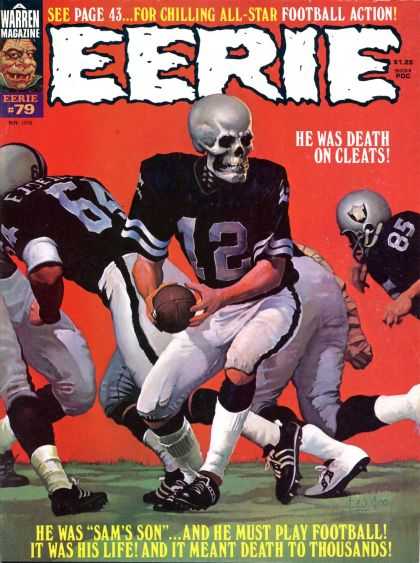
Classic Creepy Comic Covers - EERIE #79 (November 1976)
Art by Ken Kelly
Undoubtedly inspired by the success of their annual Christmas issues, Warren Magazines decided to try a number of "themed" issues during the late 70s, but few were as gonzo - and fun - as the November 1976 and 1977 offerings of Creepy and Eerie. Now, technically the latter did not do theme issues, as Eerie had become a venue for a variety of series that Warren had developed (Memo to filmmakers; there's some low-hanging fruit just waiting to be turned into incredible movies, as their "Night of the Jackass," "The Demons of Jedediah Pan" and "Hunter" are virtual storyboards for instant classics). But in the Fall of 1976, as leaves turned to gold, the covers of these two magazines turned vibrant green and blood red. Creepy #84 sported a cyborg pitcher, hurtling a live hand grenade from the mound and right at the reader, and Eerie #79 suspended its serial policy for the last tale of the issue, a wacky excursion into gridiron grue called "Sam's Son and Delilah," courtesy of author Bruce Jones and the art team of Carmine Infantino and Al Milgrom (the former having been summarily dismissed from DC after a lifetime's commitment to the company, the latter on leave from Marvel). They company repeated the experiment one year later, even though the four sports-themed covers ('77's featured football and basketball) fronted some of the worst-selling issues in the company's last years. Gluttons for punishment, Warren even released the two '76 covers as posters, the perfect companion to those nubile, scantily clad Frazetta ladies languishing in the embrace of a beefy barbarian. You know, for teen Horror fans who wanted to prove they were, you know, tough.
The MVP for the Sports/Horror issues (Sporror? Horts?) was writer Roger McKenzie, a facile wordsmith who demonstrated at a number of companies the knack of writing in a style to match the demand. Not really possessing a unique voice of his own, he could approximate the style of any of Warren's other authors, but excelled when creating his own grisly EC-esque variations, or poignant tales that all but called for Rod Serling to step out at the end and deliver a postscript. "Elixir," about an aging hockey player and his longing for youth and vitality, was a nice, lyrical effort. McKenzie would also go on to stints writing Captain America, Ghost Rider and Daredevil for Marvel, and is the oft-overlooked scribe of Frank Miller's first issues on the character. He's been MIA since the early 80s. Where be you, Mr. McKenzie? The Jar is a big fan.
Enjoy your Super Bowl Sunday, gentle Jarheads. And keep an eye out for commercials for Shutter Island and The Crazies. So it won't be a totally Horror-free experience...
Frozen Out
STAFF MEMBER / GRUNT - "Gee, a lot of people are asking about/for (name of movie) tonight."
BOSS - "Isn't that interesting. Can you stick around tonight for inventory counts?"
Unfortunately, the rollout campaign for Paranormal Activity led many to believe that groundswells and public demand had an effect on release schedules, but this was all part of an ingenious master plan on Paramount's part, when they had every intention to break the movie wider once they saw the phenomenal dollars pouring in from the first round of bookings. And rest assured, if you're requesting Frozen, there are also folks requesting films like A Single Man or An Education. Take heart - your genre film has a much better chance of breaking wider than an art house release, which usually requires some major nominations or awardage to move outside of a limited platform release.
 Some twenty or thirty years ago, it was marginally better. If your local theater was a single-screen art house, or that rarity in the 80s - a Mom & Pop affair - you might be lucky and get your movie for a week, and several weeks or even months after its national debut. (Having spent much of my life in a much smaller town in Central WI, there were even occasions when the cinema got a film after it was out on VHS - after the then-standard six month window of theatrical release.) But again, that would be at the discretion of the booker, who would be assigning the theater its movies from a place far, far away, not knowing or caring what audiences were demanding. I can only point to one time that my entreaties caused a theater to book a film that I personally requested. It was 1988, and it was Madison's famed Majestic Theater, which for years as part of the Landmark chain used to publish a calendar of upcoming films, and when a new one would hit the racks across the city, film fans would excitedly peruse it and plan their next couple of months of entertainment. Occasionally there would be one week in each calendar that was filled with irregular releases that stayed for only a few days, and that year, after I had been a notorious pest about the film, they actually managed to book the creepy delight Paperhouse. For two days. In the middle of the week. And no matinees. I was so proud...
Wanna see Frozen? Contact your friends in a city where it's playing, tell them to get their girdles in gear and see it themselves. Like everything in this life, it's all about the dollars.
Friday, February 5, 2010
Monsters! Aliens! Bizarre Creatures!
 If that four-word slug has any particular meaning to you, then you, gentle Jarhead, are old. Or at least old enough to remember the humble, haphazard beginnings of Fangoria magazine - launched in 1979 with The King of the Monsters himself in all of his train-munching majesty on its cover. But not even Godzilla could rouse the curious to pick up that periodical from the newsstand and carry it to the checkout with intent of purchase. (A frank confession - I was one of those who remained skeptical about the latest product from the friendly folks at Starlog, and did not pick up that charter issue. And one of the reasons I did not was that, everywhere I went, the issues I found were well-worn, bruised, printed with the marks of thousands of thumbs. I was, and still am, kinda anal about my magazines. And it looked as if a lot of fans were curious but unconvinced. It was 1979, the economy was a bitch, and I was struggling just maintaining my steady diet of Marvels and Warrens.)
The magazine struggled as well through its first year,
 and not even covers featuring Mr. Spock or the droids of Star Wars could entice enough readers to sign on to make Fangoria turn a profit. It was the grim visage of Jack Nicholson from The Shining, casting a baleful gaze from the cover of issue #7, that turned the terror tide in the summer of 1980. By the time issue #9 hit the stores, I was starting my freshman year in college. I had recently given up Forry Ackerman's Famous Monsters of Filmland - essential for my pre-teen years, and never recalled with anything other than great fondness, but I was a Man now, baby, and time to put away childish things. And there were many things that you could say about the dada-esque image of Rory Calhoun sporting a swine's head and brandishing a chainsaw, but "childish" would be damn near the bottom of the list of adjectives that came to mind. Issue #10's cover was pure Money Shot - the tragic consequences of an invasive mind probe from a Class A Scanner - and I was hooked, snapping up subsequent issues with glee.
In my mind, Fango established itself as the natural successor to FM, and when issue #25 allowed a forum for Ackerman to publish the censored editorial that was to have marked the end of his involvement with the magazine he launched over twenty years earlier, it not only turned a spotlight upon the ignominious treatment Forry was dealt at the hands of a new regime at Warren, it also served as a symbolic passing of the torch - as well as a source of pride for us Fango fans who secretly feared that the new mag might be presenting itself as the cooler, hipper model of FM. Instead, it proudly celebrated its debt to Ackerman and its determination to be the new voice for Horror in Entertainment. Over at FM, the usurpers' days were a numbered few.
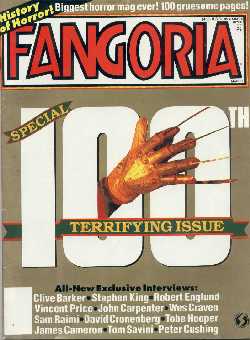 Over the next three decades, I was a somewhat unfaithful reader, but probably wound up buying about 75% of Fango's run to date. ("Gee, do I really need an issue that highlights another crappy sequel to Child's Play?") I was working in radio when Fango hit #100, and had the pleasure of conducting a lengthy interview with editor Tony Timpone at a time when the outlook for cinematic Horror looked pretty bleak - and, by extension, Fango's chances of survival. But just as Horror waxed and waned, so too did the magazine, remaining a constant, comforting fixture on the racks. If there was Horror, there was Fangoria...and vice-versa. (And another frank confession - The magazine always kinda scared me a little. As their editors sought to publish only the grisliest, bloodiest pics they could find from the new releases, I was that rare reader who would have preferred a bit of restraint on their part. Seeing the graphic stills before seeing them onscreen diluted their impact for me, and allowing me the opportunity to view them at length in vitro made them less effective when seen in vivo. Am I weird that way? It's a rhetorical question, gentle Jarhead.)
The Interweb is rife this week with stories about Fangoria's apparent, or imminent, demise. I'm not going to recount the elements here, nor am I privy to any insider information. I can report that a trip to four area bookstores this afternoon revealed that, not only was Fango missing from their shelves, but, ominously, so too were the most
 recent issues of competitors Rue Morgue and HorrorHound, leading me to believe that newsstand sales have been so poor that stores and distributors in the Milwaukee area have reached an unpleasant decision on the profitability - or lack thereof - of stocking the Horror trades. Many are tsk-tsking these developments, saying that they are simply the natural outgrowth of the difficulties all magazines are facing in this Interweb era. Count me among the fans hoping for Fango's survival. (I'd love to see a re-working similar to what Newsweek has done, with more analysis and features tied less directly to individual releases, but I'm sure THAT would last all of one issue. However, the covers have got to be re-worked, and fast. I know enough about magazine publishing to see that these lookalike "big head" wraps violate a primary rule - Make sure your new issue looks noticeably different from its predecessor, so regular readers can clearly see it's time to pick up the latest.) If Horror loses one of its biggest and most-recognizable champions for over thirty years - at times it's only champion - the genre will be the poorer for its absence.
And not all the bloggers in the blogosphere can or will make up for that loss.
Tuesday, February 2, 2010
Terror Trivia Tuesday for 2/2! (This may never have a cooler title than that.)

Five performers have been nominated for an Academy Award for acting in films based on the works of Stephen King. Name them.
Monday, February 1, 2010
Haunted by Horror...Briefly
 In 1973, Stan Lee and the Marvel Comics Group fired a shot across the bow of publisher Jim Warren and his line of black and white Horror magazines, entering the field with much fanfare and aplomb by launching a quartet of comic titles (Dracula Lives, Monsters Unleashed, Tales of the Zombie, Vampire Tales), as well as a challenger to the institution that was Famous Monsters of Filmland, the House of Ideas' Monsters of the Movies. Within two years, they were all canceled due to poor sales, and Warren could exult in his unassailed status as an industry leader. But lost in the shuffle was one periodical that constituted a grand experiment on Marvel's part; a digest of horror and fantasy fiction, one that would interest followers of the Marvel Universe, and yet remain separate and distinct from the world of Dracula, Man-Thing, Morbius and Simon Garth, the Zombie.
The title was The Haunt of Horror, and in March of 1973, it could be found on newsstands in an unfamiliar place for Marvel - right next to the science fiction digests like Analog, Galaxy, and The Magazine of Fantasy and Science Fiction. It had been advertised for months in the pages of every Marvel color comic title as part of Stan Lee's Soapbox, the promotional text page that made Marvel readers feel as though they were part of one of the coolest clubs in the world. Before HoH was launched, the company had spent the last five years adapting classic tales of Horror and SF in such titles as Tower of Shadows, Chamber of Chills, Supernatural Thrillers and Worlds Unknown. (Much of this increased activity was the result of the Comics Code loosening its restrictions on what was permitted regarding stories of the supernatural.) Marvel readers were familiar with the writers and artists of the Bullpen, but soon became just as aware of such authors as Lovecraft, Howard, Bloch, Sturgeon and Derleth. What EC Comics had done in the 1950s for Ray Bradbury, Marvel did for a host of writers, with many contemporary names like Harlan Ellison and Ron Goulart becoming friends with various Bullpenners.
 To serve as editor for the title, Lee selected Gerry Conway, who had started his professional comics career for DC writing stories for their Horror titles (House of Secrets, House of Mystery) when he was only 16. Within a year he was also contributing to Marvel's Chamber of Darkness and Tower of Shadows, but by 1971 he had transitioned over to the superhero titles, eventually accepting stints as the scribe for Daredevil, The Incredible Hulk, Fantastic Four and, most famously, The Amazing Spider-Man; when the first issue of HoH reached the stands, Conway was mere weeks away from rocking the Marvel Universe with the still-controversial death of Peter Parker's then-girlfriend, Gwen Stacy. But for the purpose of this new project, Conway's primary credential may have been that he was a published author, as Ace Science Fiction had released his 1971 novel The Midnight Dancers. (He would later sell DAW Science Fiction his novel Mindship for a 1974 release.)
Marvel attempted a blend of established writers alongside neophytes, as well as some names familiar to comic readers. In addition to familiar names like Ellison and Howard, the first issue included a tale by noted fantasist R.A. Lafferty (whose borderline surrealism makes him incapable of easy categorization), an early effort from Horror master Ramsey Campbell, a piece from DC competitor and Batman scribe Dennis O'Neil, as well as some of the first published fiction from A.A. Attanasio and David R. Bunch. There's also "The First Step" by George Alec Effinger (writing under the pseudonym John K. Diomede), the initial story in what was clearly meant to be a series following the exploits of Dr. Warm, an investigator of the supernatural, and written in the style of 1930s-era Weird Tales.
But dominating the first and second issues of HoH was the reprinting of Fritz Leiber's 1953 novel Conjure Wife (also the inspiration for the 1962 movie Burn, Witch, Burn aka Night of the Eagle). The Bullpen had great respect for the works of
 Leiber, with letters pages often making note of the company's long-held desire to adapt his sword & sorcery stories of Fafhrd and The Grey Mouser to the printed page. (DC scored the rights, unfortunately, and the series Swords of Sorcery - written ironically by O'Neil - was canceled after only five issues.) Lieber's story of a college professor whose career may be receiving aid from the efforts of his spell-casting better half served as a touchstone for the new digest. Conway writes in the debut issue's editorial...
Perhaps the best way to illustrate our intentions is to point to the serial featured in this issue, Fritz Leiber's Conjure Wife. We wanted to lead off our first issue with a story that would clearly indicate our tastes, a story that we considered the ideal - and we could think of no better book than Leiber's. It contains all that we think a novel of horror and the supernatural should contain: mystery, excitement, suspense, believable characters in an all-too-believable situation. This is our ideal.
The issue was supplemented with art from the Bullpen's finest talent, with moody contributions from Gene Colan (Tomb of Dracula), Frank Brunner (Dr. Strange), Mike Ploog (Werewolf by Night), as well as early work from Walter Simonson, later to do a highly-regarded stint on The Mighty Thor. Baird Seales contributed a book review column ("Boo Kreview"), and would later do the same for Asimov's SF Magazine. The debut was packaged in a beautiful cover from Gray Morrow, and was released to the world in March 1973. Though sold as a bi-monthly, the debut bore a June 1973 date, a bit of publishing legerdemain that ensured the title would remain on the racks for three months to give readers time to discover it.

Unfortunately, the greatest discovery was made by Conway and the company, as they picked up the debut and found that Harlan Ellison's story "Neon" had been printed with the final pages reversed! The notoriously cantankerous Ellison sent a typically puckish letter that was equal parts good humor and pique, and Conway made amends by re-publishing the story in the second issue, pages in the correct order, and sporting a stunning illustration from legendary artist Kelly Freas. However, many observers - myself included - believed that the story was actually improved with the error. It was later to be collected in Ellison's landmark Deathbird Stories.

Three months later came the second issue, with Freas gracing the cover with a va-va-voom approach that surely had to goose sales - as well as create some negotiations for young fans who had to ask parents for shekels to buy something that was conspicuously not the next issue of The Invincible
But then something happened. Before the official sales figures could come in from the first two issues, Marvel relied on anecdotal evidence that indicated the digests were sitting on the racks, unnoticed and unsold. A third issue was awaiting publication, and was being pre-sold in the company's other b&w titles (along with a striking Hellhound cover that would have surely garnered interest), but the powers-that-be threw in the towel, and it never saw publication. Bullpenners who remember the project recall that the eventual sales figures were not that dire, and HoH had a foundation that could have been built upon, especially given the resurgence of interest in all things horrific after the December success of The Exorcist.
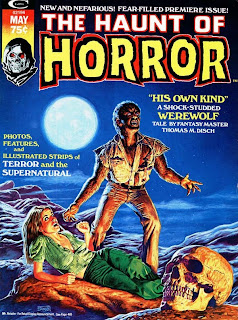 About one year later, Marvel revived the title, albeit as another b&w Horror comic magazine. There are Interweb claims out there that the print stories intended for the digest magazine saw publication in this second version, but those reports are incorrect. Only "Heartstop," a story from Effinger in the new "first" issue, was clearly intended for the digest. Future issues of this version of HoH had text stories, but they were based on Marvel's Horror characters, and so were not meant for Conway's title. After only five issues under a merry-go-round of editors, the new HoH was put out of its misery. Marvel has recently revived the name as a vehicle for noted artist Richard Corben.
The history of Marvel, especially during the 70s, is littered with half-hearted attempts at producing titles to appeal to Horror fans, with only Tomb of Dracula among the color books to make it to a 70th issue; most other titles are allowed to fade away after no more than a dozen issues or so. So it's not out of character for the company to be skittish about a magazine that was such a leap of faith (Conway even used the word "uneasy" in his first editorial to describe Marvel's disposition about the project). Copies of these two issues can be had for not unreasonable prices on eBay and other sources. Horror fans are advised to check them out, and wonder what might have been had Marvel shown a fraction of the bravery exhibited by their superheroes, and given The Haunt of Horror support that matched the enthusiasm of its True Believers in the Bullpen.
Subscribe to:
Posts (Atom)