...and my Christmas wish is that all the evil people in cinema will join hands and sing a song of harmony and peace....
Saturday, December 19, 2009

Friday, December 18, 2009
Honey, here's that Christmas present you AXED for...
This is not an official Classic Creepy Comic Cover posting here, but rather a tidbit for you to nosh upon, Gentle Reader, as I prepare the magnum opus for this here Christmas season. But I would be remiss if I didn't pass along a delightful little morsel (I must be hungry) that I happened upon through the referral of a friend's blog. I'm guessing most of you are quite familiar with the EC tale "And All Through the House...," a yuletide tradition since its appearance in the March 1954 issue of The Vault of Horror, especially after its adaptation as part of the 1972 Amicus anthology Tales of the Crypt, as well as being one of the charter installments of the HBO series of the same name, first telecast in the heat of Summer 1989. Now, here's the inimitable cover provided by soon-to-be Editor of VoH, Johnny Craig...

(I've always found it interesting that the actual story, written and illustrated by Craig, flips the image that you see here. It's the wife who commits the murder, and then must grapple with the psychotic Santa. So, is it more misogynistic to have the woman as victim, or as homicidal harridan? Discuss.) Anyhoo, it turn out that this is one of the covers recently homaged by the irreverent and essential Fred Hembeck in a series of re-workings of iconic comics...
 Fred tells the story of how this artwork went unsold, but his website does not list this as one of the pieces he is offering to the market anymore, so I'm guessing he found a taker. Wouldn't this make for a charming Christmas card, especially for your friendly local cleric or law enforcement official? They'll be sure to keep an eye on you...and the missus...

(I've always found it interesting that the actual story, written and illustrated by Craig, flips the image that you see here. It's the wife who commits the murder, and then must grapple with the psychotic Santa. So, is it more misogynistic to have the woman as victim, or as homicidal harridan? Discuss.) Anyhoo, it turn out that this is one of the covers recently homaged by the irreverent and essential Fred Hembeck in a series of re-workings of iconic comics...
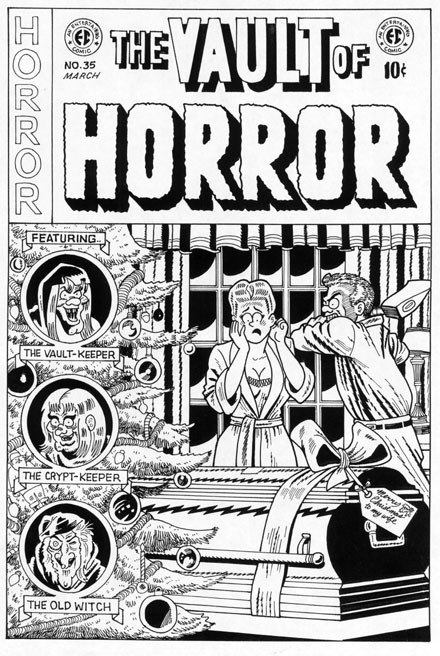 Fred tells the story of how this artwork went unsold, but his website does not list this as one of the pieces he is offering to the market anymore, so I'm guessing he found a taker. Wouldn't this make for a charming Christmas card, especially for your friendly local cleric or law enforcement official? They'll be sure to keep an eye on you...and the missus...
Dan O'Bannon, 1946-2009
Everyone has a movie like this, especially genre fans. It's a movie that you press to your heart with a love that defies logic or common sense, a love that, among those of more refined tastes, dares not speak its name. Maybe it's a movie that you encountered in a deserted cinema, a movie that found you, sitting all by yourself, and whispered in your ear. It sidled up next to you, enveloped you in one overpowering arm, drew you into itself...and then proceeded to have its cheap and tawdry way  with you. Oh sure, by the time the final credits rolled, you knew that you had been used and degraded - but there was just something about the way that this movie, oh, I dunno...it was different. It knew that you were different. And like Everett Sloane's girl with the parasol and the white dress, it would remain with you for the rest of your life.
My movie was - and is - Lifeforce. Yep. Lifeforce. While the rest of America was watching Marty McFly travel Back...In...Time, I was thrilling to the UK's ravishment by space vampires in a big budget epic that wedded themes from the vaunted Quatermass series to bombastic special effects and laser light shows. Let the rest of the world add money to the coffers of Universal Pictures - I had thrown my lot in with director Tobe Hooper and a man who spent a career unnamed but seldom unrecognized. He would go through life hyped as "the creator of Alien," and indeed, he gave life to Ripley and Ash and Dallas and Kane and the Nostromo and those biomechanical marvels from Monsieur Giger with the cranial carapaces and the acidy spit. He also gave us screenplays for Dead and Buried, Blue Thunder, Invaders from Mars (1986), Screamers, Total Recall and The Return of the Living Dead (which he also directed). I am confident that others will give those films the attention they are due. But he also adapted Colin Wilson's The Space Vampires into the screenplay for the hot mess that is Lifeforce. He may not be very happy with the film that is heading up this tribute from the Jar - he all but disowned the finished product - but it has gone on to cult status, testimony to the other genre junkies who felt similarly defiled and delighted, and for that, this little fanboy owes Dan O'Bannon so very, very much.
Dan O'Bannon died on December 16 after what is described in obits as a brief illness. He is survived by his wife and son.
My first encounter with O'Bannon was not only as a screenwriter, but also as an actor, as the put-upon Pinback in John Carpenter's entry into the world of moviemaking, Dark Star, which I saw in 1975 as the second half of a double feature with The Land That Time Forgot at Wausau WI's legendary Grand Theater. This sequence is often cited by film historians as a low-cost first whack at what was later to become Alien -- that is, if Ripley and company were forced to do battle with an inflated beach ball with Gill Man claws.
Thanks again, Dan. I hope you're home in time for cornflakes.
 with you. Oh sure, by the time the final credits rolled, you knew that you had been used and degraded - but there was just something about the way that this movie, oh, I dunno...it was different. It knew that you were different. And like Everett Sloane's girl with the parasol and the white dress, it would remain with you for the rest of your life.
My movie was - and is - Lifeforce. Yep. Lifeforce. While the rest of America was watching Marty McFly travel Back...In...Time, I was thrilling to the UK's ravishment by space vampires in a big budget epic that wedded themes from the vaunted Quatermass series to bombastic special effects and laser light shows. Let the rest of the world add money to the coffers of Universal Pictures - I had thrown my lot in with director Tobe Hooper and a man who spent a career unnamed but seldom unrecognized. He would go through life hyped as "the creator of Alien," and indeed, he gave life to Ripley and Ash and Dallas and Kane and the Nostromo and those biomechanical marvels from Monsieur Giger with the cranial carapaces and the acidy spit. He also gave us screenplays for Dead and Buried, Blue Thunder, Invaders from Mars (1986), Screamers, Total Recall and The Return of the Living Dead (which he also directed). I am confident that others will give those films the attention they are due. But he also adapted Colin Wilson's The Space Vampires into the screenplay for the hot mess that is Lifeforce. He may not be very happy with the film that is heading up this tribute from the Jar - he all but disowned the finished product - but it has gone on to cult status, testimony to the other genre junkies who felt similarly defiled and delighted, and for that, this little fanboy owes Dan O'Bannon so very, very much.
Dan O'Bannon died on December 16 after
 what is described in obits as a brief illness. He is survived by his wife and son.
My first encounter with O'Bannon was not only as a screenwriter, but also as an actor, as the put-upon Pinback in John Carpenter's entry into the world of moviemaking, Dark Star, which I saw in 1975 as the second half of a double feature with The Land That Time Forgot at Wausau WI's legendary Grand Theater. This sequence is often cited by film historians as a low-cost first whack at what was later to become Alien -- that is, if Ripley and company were forced to do battle with an inflated beach ball with Gill Man claws.
Thanks again, Dan. I hope you're home in time for cornflakes.
Thursday, December 17, 2009
But little Lord Jesus, no crying he makes...
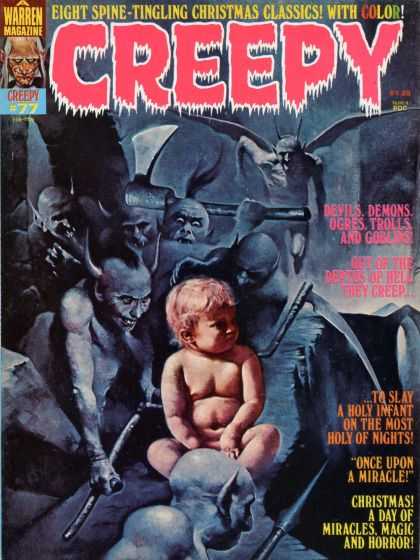
Classic Creepy Comic Covers - Creepy #77 (February 1976)
Art by Manuel Sanjulian
...but maybe it would be good if he let out a wail or two. Or demonstrated that he knows how to duck!
Having treated Jolly Old Saint Nick with bloody irreverence for the last two Christmases, Creepy turns its attention to the Reason for the Season, if somewhat obliquely. Once again, Sanjulian graces the Christmas cover with a somber tableau, and a cherubic infant that really pops as a focal point, said baby to be seen as a hoi polloi hatchling...were it not for the cover copy, which clearly intimates that this is "a holy infant on the most holy of nights."
Whoa. Jesus. I mean, really...Jesus.
This was new territory for the Warren magazines, and during the calendar year of 1975, they were exploring it between the pages of the titles. Six issues prior, in Creepy #71, readers were startled by the story "His Name Was John," from writer Budd Lewis and artist Luis Bermejo (in an experimental all-Bermejo issue, and a striking one, at that). In it, a Catholic priest is contacted by an alien intelligence that reveals that it is indeed God, and is looking for a new prophet to bring tidings to the world. At the climax, the priest is startled to find tentacles growing out of his back, as he is being changed for his new role, and is humbly resigned to his destiny. This was a far cry from the tales of vampires and werewolves that populated the mag a decade earlier. This was genuine Adult Fantasy, its mature themes going head to head with the material found in its newsstand competition, Heavy Metal. Most critics consider this period to be the zenith of Warren's achievements, with at least one story in every issue to rank among the decade's finest from any publisher (in this issue, that honor has to go to the Bruce Jones / Berni Wrightson collaboration "Clarice," which is, of all things, a poem, climaxing in a horrifically heartbreaking final panel).
However, the Christmas issues increasingly had an unpleasant knack for the maudlin and saccharine, as #77 exemplified. Stories that were low on the horror content would opt for a generic "God bless us, everyone" ending, and rank among the worst the company would ever produce. Perhaps it was hard to maintain a consistently dark tone for an entire magazine, or perhaps it was a misguided effort at variety. At any rate, the lighter fare is quite forgettable, and pales in comparison to the hard-edged tales that were vastly superior.
Monday, December 14, 2009
Terror Trivia Tuesday for 12/15!
 Promotional materials for this early 70s horror film encouraged theater managers to mail out newspaper ads and invitations for the movie enclosed in Christmas cards. This would have been an attention-grabber, since the movie opened in the United States several months before December. What was the title given to this motion picture upon its US release?
You bring strange creatures to life...You send them back!

Ten days away from the big day, and here at the Jar we're waxing wistfully nostalgic about Christmases Past. I knew that I wanted to do at least one posting this year about favorite toys as gifts, and realized that I have a pretty limited list of offerings from which to choose. It didn't take me very long before my standard Christmas wish list for Santa consisted of little more than books, records and board games (if you were a game show, and you had a Home Version, you were in the Senski household) - all of which meant that my presents were very easy to wrap, and stacked up quite nicely under the tree. However, there were a few notable exceptions, some of which may be of greater interest than others to the regular readers of this blog. And so, I give you one of the nicest things that Saint Nick ever left me in his benevolent wisdom...
Imagine if David Cronenberg had designed the Easy Bake Oven, and you would have something along the lines of Mattel's Strange Change machine (also known as The Time Machine, or even the Strange Change Time Machine, but we always just referred to it as "Strange Change"). It was introduced into the market in 1967, and that may have been the year I got one for Christmas, but I have this nagging sense it was actually a year later. With the purchase of the device, you also received a set of square plasticene "capsules," each one "containing" some kind of creature or creepy-crawler. Now, I use the quotes because the little beasties aren't actually inside of anything - they are the capsules themselves. Perhaps it's best to just roll the tape, and let the commercial do what it is that commercials do best...
Now, I put it to you - is not the sight of that octopus unfurling from that square shape just not one of the coolest things you have ever seen, even in 2009? Can you imagine the effect that this had on my little five-year-old brain? Here was my chance to be Victor von Frankenstein, Andre Delambre, and every other mad scientist I had
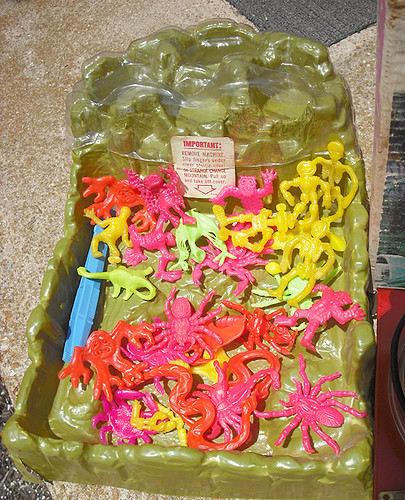 seen or read about. Delusions of godhood? The intoxication of sheer, unadulterated power? Groovy! For all the time that I played with my Strange Change machine, it never, never grew old. Sure, the little monsters never quite compressed back into the pure square shapes in which you received them; there was always a stray claw, wing or tentacle that was protruding, as if the thing was trying to escape its four-sided confines, like a plastic, prehistoric Elisha Cuthbert. You could also buy additional capsules in sets of "Creaturelings" and "Astropods," and I had a mutable menagerie that would have made Laura Wingfield chartreuse with envy - that is, were she into plastic rather than glass.
Now, you could never produce a toy like this today, and for one reason only - this bastard got HOT. Yes, essentially we're looking at a hot plate covered by a see-through plastic dome, and a unit that did not possess an on/off switch. You plugged this baby in, and it got warm, then hot, then very hot. It never actually glowed, but that was cold comfort to my often-toasted digits (the toy came with a set of tongs for creature extraction, which I used...most of the time). And that base? Metal. The vice? Metal. It all got freakin' hot, and I often wonder how many homes with shag carpeting suffered singeing from units that went unplugged. And speaking of that vice...let's face it, gentle readers, Torquemada would have had a field day with a Strange Change machine.
And my friends and I loved it. There was another downside, however. You had to be careful not to leave the creature over the heating element for too long, as they tended to scorch, and once that happened, they didn't metamorph very well. Come to think of it, there was a very limited window of opportunity if you were heating the monsters up for re-compression. Leave them in for too short a time, and you couldn't squish them together properly; too long, and the little buggers burned. Why I never wound up a master chef who specialized in perfectly-timed souffles is beyond me.
I recall there was a point when the unit just failed to heat up, and that meant trash time for Strange Change. But until that happened, this was a treasured toy from my childhood, and even now, I've got a hankering to stick a pink plastic spider under that dome...and just see what happens...
Sunday, December 13, 2009
Nackles - The TV Christmas Horror Classic That Wasn't
On December 20, 1985, viewers who tuned in to CBS' re-boot of Rod Serling's Twilight Zone were treated to a special Christmas installment of the series - or two-thirds of the hour, anyway. Three stories were slotted that night. The first was a re-working of Serling's 1960's teleplay for the orginal series' second season holiday episode "Night of the Meek," in which Art Carney played a down-on-his-luck schlub who comes upon a magical bag that's the source of every human wish (in the new version, Richard Mulligan played the ersatz Santa). The last was a simple yet profound staging of Arthur C. Clarke's immortal short
 story "The Star," in which Fritz Weaver (under the moody direction of The Outer Limits' Gerd Oswald) portrays a Catholic priest in space, his faith rocked when he discovers that the Bethlehem star was in actuality a supernova that claimed untold billions of extraterrestrial lives. The story in the middle did not have a Christmas theme, however. It was "But Can She Type?," in which Pam Dawber was a harried secretary transported to an alternate reality in which secretaries are exalted and bosses are the peons. It was a light-hearted bagatelle of a comedic piece, nothing more. It was also a substitution for what producers had originally intended to go in that slot...and what was supposed to have aired in those minutes was anything but light-hearted. It was meant to be another Christmas-themed tale entitled "Nackles," and the story of how that teleplay (which assuredly would have become an unforgettable installment of the show) got axed at the last minute made for major media coverage at the time, and the loss of a valuable creative asset to the series.
When CBS announced that
 literature to find worthwhile tales - if not classics - to adapt for the small screen. Spearheading this effort would be a master fantasist and a fanboy of the first order - Harlan Ellison. The award-winning author surely possessed the ability to rattle off a list of several seasons' worth of exemplary tales - with more than a few of them coming from his own bibliography. And while the show produced a number of noteworthy original tales, it also provided a home for masterworks by Ray Bradbury, Robert Silverberg, Theodore Sturgeon, Robert MacCammon, Henry Slesar, Stephen King and yes, Ellison himself. From all observations, the series appeared to be in the very best of hands.
Ellison has said that the year he spent with the series was one of the most enjoyable of his professional career, and, working with producer Philip DeGuere and story editor Rockne O'Bannon, the team had to feel like the proverbial sweet-toothed kids in a candy store; the hour-long format enabled stories to take the airtime that they required, rather than having one tale either stretched or cut to fit a half- or full-hour format. Yet Ellison was a frequent complainer about one element of the show - the directors. Good-naturedly tired of listening to the author kvetch about the camerawork that was being turned in, DeGuere decided to make Ellison put his money where his considerable mouth was, and direct a story for the series.
Ellison was already at work adapting
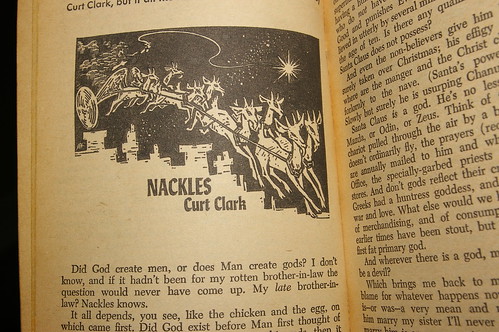
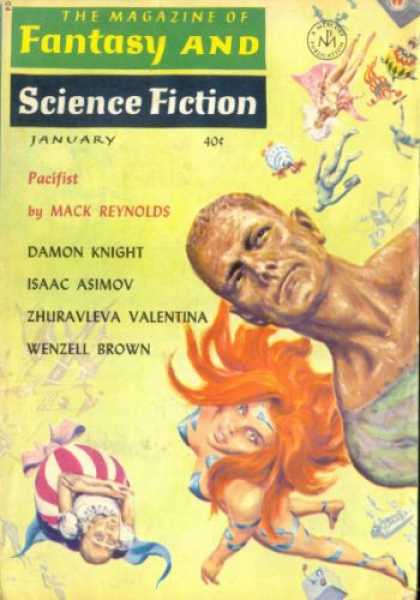 Donald (The Stepfather) Westlake's short story "Nackles" (which you can read here.) The tale, originally published under Westlake's sci-fi pseudonym Curt Clark in the January 1964 issue of The Magazine of Fantasy and Science Fiction, told of a mean-spirited and abusive husband and father who crafts the tale of an Anti-Santa as a means of keeping his unloved children in line. Dubbing the evil character Nackles, he creates a horrific figure who prowls under the crust of the Earth, powered by a team of eight dead-white goats, looking for children to abduct and eat. (I'll let you read the story for yourself to see how it turns out, gentle reader.) Ellison took the kernel of that idea and wrote a new story around it. In it, a bigoted slumlord conjures up the Nackles myth as a means of striking fear into the hearts of the African-American children who live in his tenements. But Ellison took it a few steps further. He had his slumlord tell the kids that Nackles only came for "ni***r" childen, and that the real Santa would pass them by. (Ellison also added the nasty embellishment of making the goats blind, their eyes sealed shut. After all, who needs to see underneath the ground?) And the final, finishing touch? Nackles was black, as well. It was all very powerful, in-your-face stuff for an eleven minute teleplay...and it was very Ellison.
CBS Standards and Practices got ahold of Ellison's script, and to say they balked would be putting it mildly. They were put off buy many things, but none more so than the notion of a black Anti-Santa. The network wasn't ameliorated by the notion that Nackles was the instrument of a bigot's comeuppance; they only heard the expected angry phone calls and envisioned the mountain of
 letters and telegrams. To pacify his objectors, Ellison reworked the reveal of Nackles to make him appear as a variety of minorities in a number of quick cuts, for the more important element was that a prejudiced bad guy receive his just desserts. The author thought the conflict resolved and went into pre-production, perfectly casting Ed Asner as the slumlord.
They were only days, even hours from shooting, when the network struck again, and this time, there was no middle ground - they were pulling the plug on the production. A stunned Ellison threatened to walk away from the show, CBS called his bluff, and, in Variety parlance, he ankled. It was a lead story in the news section of TV Guide, and even made a number of national papers, but the angle on it was not flattering to Ellison. He had crafted a story that featured an evil black Santa, and the fact that the character was there to deliver a reckoning got lost in some of the coverage. Those who rejoiced at Ellison's role with the series were crestfallen but unsurprised, as the prickly writer had a legendary
 reputation for contrary behavior, and I know that I was wondering how long he would be able to keep his temper in check. (I was glad at the time to learn that it was a contretemps concerning the network and not his co-workers, and in the DVD commentary for the first season, Ellison certainly sounds like a man who was enjoying coming to work every day.) His side of the incident - as well as his teleplay, revisions, and Westlake's story - can be found in his 1998 collection Slippage. This marked the second time in the space of a year that a major media outlet grew skittish at the concept of a Santa Claus who was not all mercy and sweetness and goodness and light, but, unlike the movie Silent Night, Deadly Night, "Nackles" was unable to be preserved in any format other than typing paper.
Subscribe to:
Posts (Atom)