...make sure it's the one advertised with this trailer.
Saturday, December 12, 2009

Friday, December 11, 2009
The snow, the beautful, lovely snow, drifting and falling about her...

Great Tales of Horror - THE DRIFTING SNOW by August Derleth
Originally published in Weird Tales, February 1939
I spent most of my life in that part of Central Wisconsin that author August Derleth christened the state's "Great Dead Heart" - a flat and featureless region either side of the geographical spine that is Interstate 39. Beating at its very core is the hamlet of Plainfield, where residents still speak of "Eddie" and the hideous things that Mrs. Gein's boy did prior to his November arrest in 1959. As stunned as the rest of the nation was to learn of Ed Gein's atrocities, there was a muted understand among many Wisconsinites. They knew that, in a place like the Great Dead Heart, winters could be long, bitter, merciless, forcing the simple folk to hunker down and pray for an early Spring that seldom arrived. These were the perfect conditions to drive the easily-susceptible quietly, irrevocably mad. In Wisconsin, Winter was a time of abject horror.
 No other author devoted more of his career to the horrors of the Badger State than native son Derleth. He grew up in Sauk City and, after a time spent in Madison earning his college degree, returned to his tiny home town to write. And write. And write. By Derleth's account, he was able to produce over a million words a year, and state library bookshelves groan under the weight of Derleth's journals, volumes of poetry and short stories, extensive Wisconsin histories, and an array of novels in genres as diverse as love stories, detective fiction, science-fantasy, and, of course, horror. As the locals called him, "Augie" began writing at the age of 13, and within three years was able to sell his first short story to the Magazine of Record where Dark Fantasy was concerned, Weird Tales. He became a regular contributor, as well as a close friend of such peers as Manley Wade Wellman, Robert Bloch, Frank Belknap Long, Donald Wandrei and H.P. Lovecraft.
After Lovecraft's death in 1937, Derleth and Wandrei attempted to interest publishers in compilations of their late friend's work, but when no company would bite, they created Arkham House, named after HPL's fictional Massachusetts setting for much of his work, and began publishing the work on their own, operating out of Derleth's own home and adjacent stone shed. (Derleth is credited with coining the term "Cthuhlu Mythos" to describe HPL's universe of dark Elder Gods, with hundred of writers later contributing
 to the Mythos, including Derleth). Within a few years, Arkham House was issuing volumes that became instant collectors' items, and written by everybody who was anybody in the Dark Fantasy field, including Ray Bradbury, Robert E. Howard, Algernon Blackwood, and the first US editions of works by UK authors Brian Lumley and Ramsey Campbell. The imprint continued for years after Derleth's death in 1971, but has unfortunately not published a new title since 2006.
When Derleth's "The Drifting Snow" was published by Weird Tales in 1939, it was under the pseudonym Stephen Grendon, a Derleth creation that made it seem as if the magazine had more contributors than it did. Years later, the author would use that same name as his alter ego in a series of ten juvenile mysteries - a la Hardy Boys - known as the Mill Creek Irregulars, and based on stories from Derleth's own childhood. I don't recall where I discovered this story first - it is one of the most-anthologized tales of (unusual) vampirism ever written, and was later collected in the 1948 Derleth story compilation Not Long for This World, but I do recall reading it for the first time and being thrilled that the text mentioned the city of Wausau, only fifteen minutes away from where I grew up. Derleth had an ability to weave all of Wisconsin into his terror tales, and, even though the area known to us Badgers as "Up North" sounds ever so much closer to God, it is a destination which lies in an altogether quite different direction.
Remember - Snow Vampires may be beautiful and enticing, but for your own sake - leave the curtains closed during a snowstorm.
You can read "The Drifting Snow" here. Any anthology of classical vampire fiction that does not include the story should be viewed as suspect.
Thursday, December 10, 2009
Gene Barry, 1919-2009
 Choose any one of Gene Barry's television series - The Name of the Game, Burke's Law or Bat Masterson - and you wouldn't be finding a character that was appreciably much different from the other two; suave, solid, resolutely masculine. He was perhaps more a presence than a performer. Indeed, it was that sense of masculinity that made his appearance in the 1984 Broadway hit La Cage aux Folles a casting against type to end all other castings against type. (America was surprised, but Barry was an old pro at musical theater.) For me, he will always be the hero that defended Earth against marauding Martians in George Pal's stunning mounting of H.G. Welles' War of the Worlds. When CBS played this frequently in their evening movie slots during the 1960s, it was surefire nightmare fodder for small fry, especially the taut sequence in the abandoned farmhouse. Let another 50 years of technical advancements go by - viewers will still be marveling at the craftsmanship behind this 1953 classic that set the bar so very high for future space invasion movies. And maybe the common cold accomplished what Gene Barry could not. I was always glad he was on our side.
Barry died today of undisclosed causes at the age of 90.
BOOOOOM!!! - - - Toyce!
While ambling through YouTube and looking for trailers for an upcoming post, I happened upon a teaser that I have been looking to see again for quite some time that has just recently been uploaded. During the Summer of 1992, theater owners were attaching the teaser trailer for Barry Levinson's Christmastime offering Toys to every film they could, and getting audience reactions that were, in a word, spectacular. For years, this was a dream project for the director, but a whimsical, surreal allegory for the growth of the Military / Industrial Complex was going to prove as hard a sell to audiences as it was when pitching it to the studios. Levinson got it made on the basis of his Oscar for Rainman (and that film's massive box office), but what kind of teaser to do? Especially when, in those pre-Interweb days, they were intentionally keeping the storyline a secret for as long as possible? Answer - point the camera at star Robin Williams and just keep it rolling. By this time Williams was a three-time Oscar nominee, and would later be packing them in the cineplexes as the voice of Aladdin's genie. This entirely-improvised teaser made audiences weep with laughter -- but was ultimately a failure in generating interest, for Toys opened one week before Christmas 1992 to lackluster business and lukewarm reviews. This teaser is a reminder that, Old Dogs to the contrary, Robin Williams used to be one funny sumbitch on the big screen.
Wednesday, December 9, 2009
The stockings were hung by the chimney with care...
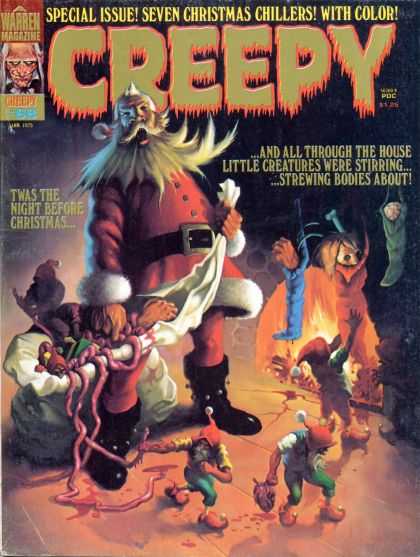 Classic Creepy Comic Covers - Creepy #68 (January 1975)
Art by Ken Kelly
Did I tell you that this one was gonna be something else, er no?
The very first issue of Creepy that I bought off of the newsstand was #73, cover dated August of 1975, and sporting an atypical science fiction cover of a futuristic suited astronaut engaged in zero gee combat with an advancing robot, the pair floating high above the planet Mars. I think this tableau must have appeared safe to me, because, truth be told, up until that point Warren's comic magazines...uh...scared me a little. I had been a regular reader of the company's Famous Monsters of Filmland for about four years, and also purchased many of Marvel's efforts at Horror b&w magazines; graphic though they were, they still seemed to operate within the confines of the Marvel Universe. The Warren titles felt different, dangerous, filled with more overt sex and gore. But hey, I was twelve years old now, and it was time to put away childish things. Bring on Uncle Creepy!
One of the greatest things about the Warren titles, and a sheer act of genius in my estimation, was their offering of back issues for sale in every single mag. Open the back end, and you would find a double-page spread of Creepy covers, miniature thumbnail shots of the entire run up to that point. Filling out the second page was a listing of classic story titles, including such interesting-sounding tales as "Like a Phone Booth, Long and Narrow" and "The Beckoning Beyond." Issue #73 hooked me and hooked me hard, and being the fetishistic completist that I am, I started ordering up the previous issues in reverse order, finding a newly-discovered passion for household chores that paid stipends of a dollar here, a dollar there. I still remember the thrill of opening that first package of fifteen or so back issues, and the revelation of seeing, in color and full-size, the covers that tempted me so in miniature.
And that's how I first saw the cover to #68. I could tell by the thumbnail that it was a Christmas issue, I could tell it was Santa, I could tell it was elves, I could tell they were by a fireplace. But I couldn't tell what it was they were doing exactly, or certainly what it was that Santa had in his bag.
Almost 35 years later, and I can't for the life of me figure out how the hell they got away with this. In its 149 issue history, the magazine never featured anything nearly as gruesome, as grisly as this Ken Kelly masterpiece. Sure, there were a pair of decapitations and a "Murders in the Rue Morgue"-inspired throat slashing, but those were models of restraint compared with this. If the magazine had received any complaints about the "Santa with an Axe" of one year prior, then it was cheekily doubling down with its second Christmas issue (and raising the price by yet another quarter to $1.25 - the sales on these holiday issues must have been good).
By his own admission, no one did more covers for Warren during their history than the Frank Frazetta-trained Kelly (over 150), and seeing his growth as an artist over the years was a wonderful thing to behold. Together with Sanjulian, Enrich, and the incomparable Basil Gogos over at FM, those four made the Warren name synonymous with sophisticated dark fantasy, and in the case of Creepy, Eerie and Vampirella, unashamedly adult. To be fair, it is also easy to look at his output and find the occasional cartoonish rush job, but there aren't many of these.
Were there complaints? This time, yes, as the letters page seemed to indicate that the shocked outnumbered the supportive. (Some readers thought those were the body parts of children, but I never quite saw that myself.) The Warrens never again swung for the fences as boldly as they did here. Oh, the inside stories were often jaw-droppingly graphic (there's a Bill DuBay / Luis Bermejo effort in Creepy #95 entitled "Orem Ain't Got No Headcheese" that still makes me kinda queasy just thinking about it), but relative restraint followed this beauty. Me, I'm glad as hell they were able to get away with it, if only once.
You can buy an autographed print of this canvas (called "Season Greetings") by going to Ken Kelly's website here. Methinks I might have just made a few sales...
Tuesday, December 8, 2009
Tuesday Terror Trivia for 12/8!
 What major U.S. city was the birthplace for protests that ultimately resulted in Tri-Star Pictures pulling the killer Santa movie Silent Night, Deadly Night from theaters nationwide in 1984?
Monday, December 7, 2009
A History of Hollywood Holiday Horror
A while back I posted a look at CinemaScore, and was struck by the fact that some of the lowest-scoring movies released in recent years were horror films opening on Christmas Day. This got me to thinking - I know that the end of the year is prime time for big budget fx blockbusters, comedy, tearjerkers, children's animation and Oscar contenders...but Horror? Looking at the days to come, there's nothing on the horizon for Christmas 2009 or earlier, but it seemed to me like recent years have had options for the horror fan. Granted, they may not have been box office successes, but at least they were there. So, that meant it was time for one of those "The Jar Investigates" Reports that you know, love and can't live without.
 Let's start with the towering titan of them all, 1973's The Exorcist. Technically, this was released the day after Christmas, but America had been hearing about this film for months, as William Peter Blatty's novel had been an unavoidable best-seller in both hardcover and paperback, the latter of which had been trumpeting the movie's imminent release on its cover for months. Once it hit theaters, the papers were filled with stories of long lines, sold out showings, and patrons who screamed, fainted, vomited or even miscarried. It was on its way to becoming a cross-cultural phenomenon, and a new generation was believing in Satan as more than a concept or fantastical figure. However, this was primarily a token release to theaters to qualify The Exorcist for the Oscars (it worked, scoring 10 nominations). Warner Brothers subsequently crafted a platform release for the picture that resulted in large swaths of the nation waiting weeks, even months to see it. Given that this was the pre-multiplex era, that meant some theaters didn't get a print of the film until well into Spring, and it played nationwide for much of 1974. Total Box Office - $204 million, and, adjusted for inflation, the second highest-grossing horror film of all time after Jaws.
One year later, audiences got their horror mixed with humor with Mel Brooks' instant classic Young Frankenstein, released wide by 20th Century Fox on Dec. 15, tussling it out with The Towering Inferno for bragging rights as THE movie to see that Christmas. Although the burning skyscraper eventually triumphed, shed no tears for Victor von Frankenstein's creation. In the same calendar year, audiences had made Brooks' Blazing Saddles the #1 movie of 1974, and, combining it with Young Frankenstein's $86 million, there was only one candidate for 1974's Entertainer of the Year. (I should also note that October saw the mostly drive-in release of The Texas Chain Saw Massacre. It was still making its rounds nationwide, so if you lived in a warmer clime, you could have had yourself a Leatherface little Christmas.) December 20 also saw the opening of Black Christmas, the influential slasher from director Bob Clark, but with a limited number of screens, it managed $4 million; not a lot, but a considerable return on its $686,000 investment.
We didn't really get anything timed for Christmas 1975, except that summer smash Jaws was still playing in hundreds of cinemas across the country on Christmas Day, because, hey, it takes time to vacuum up $260 million dollars. Hell, here in the Midwest there were probably folks afraid of going ice skating, lest Bruce break through and gobble them up. Jaws also continued to whittle away at the Hollywood mindset of the platform release for genres like horror, action, suspense and thrillers. We were slowly being conditioned to want to see the newest movies NOW, and multiplexes were gradually expanding in quantity and screenage.
 Newspaper ads in 1976 urged patrons to "take Carrie to the Prom for Christmas," and we did - in great numbers. With a comfortable $26 million in receipts, Stephen King and Brian DePalma were well on their way to household name status; in fact, that total was almost twice what DePalma's idol and inspiration Alfred Hitchcock earned that year with his final picture, Family Plot. The picture carried over (no pun intended) into the new year, Academy members saw fit to nominate stars Sissy Spacek and Piper Laurie for Oscars, and viewers were ready for whatever the gentleman from Maine was willing to serve up (Salem's Lot for TV, and The Shining for bookstores and the big screen).
After the game-changer that was 1977's Star Wars, studios saw fit to push high-end sci-fi to holiday viewers for a few years instead, with 1977's Close Encounters of the Third Kind and 1978's Superman being the box office juggernauts of those respective years. Sci-horror was able to represent with Philip Kaufman's intelligent re-imagining of Jack Finney's Invasion of the Body Snatchers. It hit theaters just three days before Christmas, making it the first movie we're considering to be slotted as a true holiday option for filmgoers, and not just a holdover from an earlier date. Audiences were receptive to the tune of $25 million, but if you looked around hard enough, you could have found a cinema willing to take your money and add it to the $47 million that Halloween was still ringing up. Talk about a nightmare after Christmas...
Newsweek had famously promoted 1979 as featuring "Hollywood's Summer of Horror," and with a listing that included Alien, The Amityville Horror, Dracula (with Frank Langella), Prophecy, and even such low-budgeted knockouts like Dawn of the Dead and Phantasm, audiences were just plain screamed out. They spent the last Christmas of the 70s enjoying Star Trek: The Motion Picture, Kramer vs. Kramer and The Jerk.
 The 80s bring about a shift in Horror, with low-budget, independent slashers following the Halloween model, and incapable of mounting the kind of wide release and promotional campaigns to allow them to compete in the cutthroat Christmas market. We don't get a Christmastime horror flick until 1981's glossy version of the Peter Straub best-seller Ghost Story, its winter-swept settings making it a natural for a December 18 premiere. However, despite Universal's best efforts at selling it (after all, according to the lyrics of "The Most Wonderful Time of the Year," Christmas is a time for "scary ghost stories," right?), the finished product proved too reserved and remote for audience tastes, and it was considered a major disappointment with only $16 million banked. Sadly, it also effectively ended Hollywood's interest in future movies from Straub.
We must wait for two more years for another December horror release, and this one flames out even more spectacularly than Ghost Story. F. Paul Wilson's best-seller about the WWII discovery of a golem by Nazi forces got turned into the hazy echo-chamber that was Michael Mann's 1983 staging of The Keep. It was meant to be one of Paramount's high-profile end of year offerings - alongside Terms of Endearment - but it was pilloried by critics and ignored by audiences. (In my local market, it made it's national debut of December 16 - and was gone within a week!) It limped to a final box office take of merely $3.6 million. In the quarter-century since, it has enjoyed a critical re-acceptance on the other side of the Atlantic, with UK magazines like Empire hailing its virtues, but it has yet to see a DVD release on these shores.
 Gentle reader, you can probably guess what happened next. Horror movies were kept off of December schedules, and fans would have to wait five years before the next holiday horror, and this one could only muster a somewhat circumscribed release at that. After its December 23 debut, I had to travel 90 minutes to find a theater that was showing Hellbound: Hellraiser II. (I went to a ten-plex in a shopping mall the day after Christmas with my best friend from college - was that dedication, or what?) Hellraiser had pulled in over $14 million the previous September, and New World allowed no grass to grow under its feet in turning out the sequel in only one year's time. Despite the fact that it played on fewer screens, the second installment of Clive Barker's opus pulled in $11.6 million - and was the bloodiest Christmas release we had seen up to that point.
Even though his name had been attached to major Summer releases and Halloween slots for almost a decade and a half, Stephen King doesn't show up in December cinemas again until 1990's Misery, with Sony downplaying the author's involvement to make their November 30 release appear less of a horror film to John Q. Public, and more like the latest effort worthy of Academy consideration from acclaimed director Rob Reiner. It worked. Considering that this was the first big studio Horror in seven years, audiences filled the seats, and the picture wound up as one of the big holiday blockbusters with $61 million, along with Kindergarten Cop, The Godfather Part III and Three Men and a Little Lady. Kathy Bates earned a Best Actress Oscar, James Caan experienced a career resurrection, and "Mr. Man" entered the vernacular for empowered women everywhere.
If you squinted hard enough, you could have turned 1991's Cape Fear and Naked Lunch into Horror, but even if you did, the former had died out at the box office by Christmas, and the latter never got much beyond an arthouse release. In 1992, Francis Ford Coppola's Dracula was the big Thanksgiving screener, but was largely over and done with after a month. On December 29, 1993, audiences got the tax write-off that was Ghost in the Machine, buying a mere $4 million in tickets. December 1994 was as dead for Horror as the rest of that year. Mel Brooks' sub-standard 1995 Dracula: Dead and Loving It could muster only $10 million after its December 22 unveiling.
 All of that changed in 1996. Scream hit theaters on December 20, and while adults were catching romantic comedies like One Fine Day and Jerry Maguire, teens were seeing a flashback from the 1980s - a slasher film, but one with smart, quotable dialogue, savvy in-jokes and a hip young cast. The movie opened strongly in what seemed at the time to be a triumph of counter-programming...but then the crazy thing grew...and grew...forcing entertainment reporters to use the long-forgotten term "legs." Word of mouth was contagious, as young people demonstrated the enormous influence they possessed at the box office - a muscle that they would flex once again with 1997's Titanic. The Horror genre, moribund after a decade (the 90s being especially bleak up to that point), was revived, and after putting a remarkable $103 million in Scream's kitty, moviegoers did it all over again exactly one year later with another $101 million for the sequel.
1997 was the year that Hollywood stopped being afraid of holiday horror, going so far as to open genre films on Christmas Day in the hope that young audiences would find them. The results, however, were middling. An American Werewolf in Paris took in an okay $26 million in '97, and 1998's The Faculty did better with $40 million after heavily promoting the Kevin Williamson / Scream connection, as well as its sexy young cast. (December 4 of that year also saw the premiere of Gus Van Sant's "version" of Psycho, but let's not dwell on unpleasantries, ok?) Stephen King returned in a big way in 1999's The Green Mile, amassing an impressive $136 million after its December 10 rollout. The December 22 release of Dracula 2000 managed $33 million in, of course, 2000.
The next three years - 2001 through 2003 - sawThe Lord of the Rings as the big dog scaring away all the other dogs (horror, fantasy and sci-fi) from the yard, but since trilogies can't last any longer than three installments, there followed three years with three  successive Christmas Day horror releases: 2004's Darkness ($22 million), 2005's Wolf Creek ($16 million) and the obligatory 2006 remake of the 1974 classic Black Christmas (again, $16 million). Not only were these Christmas Day horror releases, but the latter two were also two of the grisliest pictures the studios had presented all year. And, as I noted in my earlier post, these films met with terrible audience ratings, with the first two scoring the rare "F" from CinemaScore.
If previous years had the famine of only one offering for Horror fans, then 2007 was a veritable feast, with three high-profile major studio pictures from which to choose. December 14's I Am Legend was the box office colossus, taking in a whopping $256 million, leaving behind relative chump change for Sweeney Todd: The Demon Barber of Fleet Street ($52 million) on December 21, and Aliens vs. Predator - Requiem on Christmas Day ($41 million). Were I writing this blog in December of 2007, I would have proudly proclaimed that Holiday Horror was here to stay.
And I would have been wrong. 2008 and 2009 will pass without nary a genre film, although January has been a solid producer of product for the last five years or so, with such films as (quality notwithstanding) White Noise, Hide and Seek, The Orphanage, Cloverfield, The Unborn and My Bloody Valentine 3D opening to solid, if not always sustainable, business. Perhaps we're entering another dry spell for Holiday Horror. History has shown that such droughts do pass, often with spectacular results. So struggle through the next few days, horror fans. Case 39, Daybreakers, The Book of Eli and Legion all await on the flipside of 2010.
 Let's start with the towering titan of them all, 1973's The Exorcist. Technically, this was released the day after Christmas, but America had been hearing about this film for months, as William Peter Blatty's novel had been an unavoidable best-seller in both hardcover and paperback, the latter of which had been trumpeting the movie's imminent release on its cover for months. Once it hit theaters, the papers were filled with stories of long lines, sold out showings, and patrons who screamed, fainted, vomited or even miscarried. It was on its way to becoming a cross-cultural phenomenon, and a new generation was believing in Satan as more than a concept or fantastical figure. However, this was primarily a token release to theaters to qualify The Exorcist for the Oscars (it worked, scoring 10 nominations). Warner Brothers subsequently crafted a platform release for the picture that resulted in large swaths of the nation waiting weeks, even months to see it. Given that this was the pre-multiplex era, that meant some theaters didn't get a print of the film until well into Spring, and it played nationwide for much of 1974. Total Box Office - $204 million, and, adjusted for inflation, the second highest-grossing horror film of all time after Jaws.
One year later, audiences got their horror mixed with
 humor with Mel Brooks' instant classic Young Frankenstein, released wide by 20th Century Fox on Dec. 15, tussling it out with The Towering Inferno for bragging rights as THE movie to see that Christmas. Although the burning skyscraper eventually triumphed, shed no tears for Victor von Frankenstein's creation. In the same calendar year, audiences had made Brooks' Blazing Saddles the #1 movie of 1974, and, combining it with Young Frankenstein's $86 million, there was only one candidate for 1974's Entertainer of the Year. (I should also note that October saw the mostly drive-in release of The Texas Chain Saw Massacre. It was still making its rounds nationwide, so if you lived in a warmer clime, you could have had yourself a Leatherface little Christmas.) December 20 also saw the opening of Black Christmas, the influential slasher from director Bob Clark, but with a limited number of screens, it managed $4 million; not a lot, but a considerable return on its $686,000 investment.
We didn't really get anything timed for Christmas 1975, except that summer smash Jaws was still playing in hundreds of cinemas across the country on Christmas Day, because, hey, it takes time to vacuum up $260 million dollars. Hell, here in the Midwest there were probably folks afraid of going ice skating, lest Bruce break through and gobble them up. Jaws also continued to whittle away at the Hollywood mindset of the platform release for genres like horror, action, suspense and thrillers. We were slowly being conditioned to want to see the newest movies NOW, and multiplexes were gradually expanding in quantity and screenage.
 Newspaper ads in 1976 urged patrons to "take Carrie to the Prom for Christmas," and we did - in great numbers. With a comfortable $26 million in receipts, Stephen King and Brian DePalma were well on their way to household name status; in fact, that total was almost twice what DePalma's idol and inspiration Alfred Hitchcock earned that year with his final picture, Family Plot. The picture carried over (no pun intended) into the new year, Academy members saw fit to nominate stars Sissy Spacek and Piper Laurie for Oscars, and viewers were ready for whatever the gentleman from Maine was willing to serve up (Salem's Lot for TV, and The Shining for bookstores and the big screen).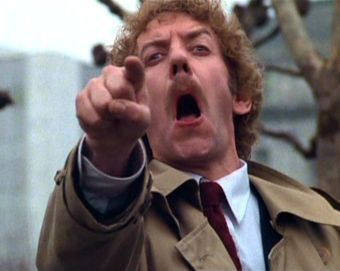
After the game-changer that was 1977's Star Wars, studios saw fit to push high-end sci-fi to holiday viewers for a few years instead, with 1977's Close Encounters of the Third Kind and 1978's Superman being the box office juggernauts of those respective years. Sci-horror was able to represent with Philip Kaufman's intelligent re-imagining of Jack Finney's Invasion of the Body Snatchers. It hit theaters just three days before Christmas, making it the first movie we're considering to be slotted as a true holiday option for filmgoers, and not just a holdover from an earlier date. Audiences were receptive to the tune of $25 million, but if you looked around hard enough, you could have found a cinema willing to take your money and add it to the $47 million that Halloween was still ringing up. Talk about a nightmare after Christmas...
Newsweek had famously promoted 1979 as featuring "Hollywood's Summer of Horror," and with a listing that included Alien, The Amityville Horror, Dracula (with Frank Langella), Prophecy, and even such low-budgeted knockouts like Dawn of the Dead and Phantasm, audiences were just plain screamed out. They spent the last Christmas of the 70s enjoying Star Trek: The Motion Picture, Kramer vs. Kramer and The Jerk.
 The 80s bring about a shift in Horror, with low-budget, independent slashers following the Halloween model, and incapable of mounting the kind of wide release and promotional campaigns to allow them to compete in the cutthroat Christmas market. We don't get a Christmastime horror flick until 1981's glossy version of the Peter Straub best-seller Ghost Story, its winter-swept settings making it a natural for a December 18 premiere. However, despite Universal's best efforts at selling it (after all, according to the lyrics of "The Most Wonderful Time of the Year," Christmas is a time for "scary ghost stories," right?), the finished product proved too reserved and remote for audience tastes, and it was considered a major disappointment with only $16 million banked. Sadly, it also effectively ended Hollywood's interest in future movies from Straub.
We must wait for two more years for another December horror release, and this one flames out even more spectacularly than Ghost Story. F. Paul Wilson's
 best-seller about the WWII discovery of a golem by Nazi forces got turned into the hazy echo-chamber that was Michael Mann's 1983 staging of The Keep. It was meant to be one of Paramount's high-profile end of year offerings - alongside Terms of Endearment - but it was pilloried by critics and ignored by audiences. (In my local market, it made it's national debut of December 16 - and was gone within a week!) It limped to a final box office take of merely $3.6 million. In the quarter-century since, it has enjoyed a critical re-acceptance on the other side of the Atlantic, with UK magazines like Empire hailing its virtues, but it has yet to see a DVD release on these shores.
 Gentle reader, you can probably guess what happened next. Horror movies were kept off of December schedules, and fans would have to wait five years before the next holiday horror, and this one could only muster a somewhat circumscribed release at that. After its December 23 debut, I had to travel 90 minutes to find a theater that was showing Hellbound: Hellraiser II. (I went to a ten-plex in a shopping mall the day after Christmas with my best friend from college - was that dedication, or what?) Hellraiser had pulled in over $14 million the previous September, and New World allowed no grass to grow under its feet in turning out the sequel in only one year's time. Despite the fact that it played on fewer screens, the second installment of Clive Barker's opus pulled in $11.6 million - and was the bloodiest Christmas release we had seen up to that point.
Even though his name had been attached to major Summer releases and Halloween slots for almost a decade and a half, Stephen King doesn't show
 up in December cinemas again until 1990's Misery, with Sony downplaying the author's involvement to make their November 30 release appear less of a horror film to John Q. Public, and more like the latest effort worthy of Academy consideration from acclaimed director Rob Reiner. It worked. Considering that this was the first big studio Horror in seven years, audiences filled the seats, and the picture wound up as one of the big holiday blockbusters with $61 million, along with Kindergarten Cop, The Godfather Part III and Three Men and a Little Lady. Kathy Bates earned a Best Actress Oscar, James Caan experienced a career resurrection, and "Mr. Man" entered the vernacular for empowered women everywhere.
If you squinted hard enough, you could have turned 1991's Cape Fear and Naked Lunch into Horror, but even if you did, the former had died out at the box office by Christmas, and the latter never got much beyond an arthouse release. In 1992, Francis Ford Coppola's Dracula was the big Thanksgiving screener, but was largely over and done with after a month. On December 29, 1993, audiences got the tax write-off that was Ghost in the Machine, buying a mere $4 million in tickets. December 1994 was as dead for Horror as the rest of that year. Mel Brooks' sub-standard 1995 Dracula: Dead and Loving It could muster only $10 million after its December 22 unveiling.
 All of that changed in 1996. Scream hit theaters on December 20, and while adults were catching romantic comedies like One Fine Day and Jerry Maguire, teens were seeing a flashback from the 1980s - a slasher film, but one with smart, quotable dialogue, savvy in-jokes and a hip young cast. The movie opened strongly in what seemed at the time to be a triumph of counter-programming...but then the crazy thing grew...and grew...forcing entertainment reporters to use the long-forgotten term "legs." Word of mouth was contagious, as young people demonstrated the enormous influence they possessed at the box office - a muscle that they would flex once again with 1997's Titanic. The Horror genre, moribund after a decade (the 90s being especially bleak up to that point), was revived, and after putting a remarkable $103 million in Scream's kitty, moviegoers did it all over again exactly one year later with another $101 million for the sequel.
1997 was the year that Hollywood stopped being afraid of holiday horror, going so far as to open genre films on Christmas Day in the hope that young audiences would find them. The results, however, were middling. An American Werewolf in Paris took in an okay $26 million in '97, and 1998's The Faculty did better with $40 million after heavily promoting the Kevin Williamson / Scream connection, as well as its sexy young cast. (December 4 of that year also saw the premiere of Gus Van Sant's "version" of Psycho, but let's not dwell on unpleasantries, ok?) Stephen King returned in a big way in 1999's The Green Mile, amassing an impressive $136 million after its December 10 rollout. The December 22 release of Dracula 2000 managed $33 million in, of course, 2000.
The next three years - 2001 through 2003 - saw
 successive Christmas Day horror releases: 2004's Darkness ($22 million), 2005's Wolf Creek ($16 million) and the obligatory 2006 remake of the 1974 classic Black Christmas (again, $16 million). Not only were these Christmas Day horror releases, but the latter two were also two of the grisliest pictures the studios had presented all year. And, as I noted in my earlier post, these films met with terrible audience ratings, with the first two scoring the rare "F" from CinemaScore.
If previous years had the famine of only one offering for Horror fans, then 2007 was a veritable feast, with three high-profile major studio pictures from which to choose. December 14's I Am Legend was the box office colossus, taking in a whopping $256 million, leaving behind relative chump change for Sweeney Todd: The Demon Barber of Fleet Street ($52 million) on December 21, and Aliens vs. Predator - Requiem on Christmas Day ($41 million). Were I writing this blog in December of 2007, I would have proudly proclaimed that Holiday Horror was here to stay.
And I would have been wrong. 2008 and 2009 will pass without nary a genre film, although January has been a solid producer of product for the last five years or so, with such films as (quality notwithstanding) White Noise, Hide and Seek, The Orphanage, Cloverfield, The Unborn and My Bloody Valentine 3D opening to solid, if not always sustainable, business. Perhaps we're entering another dry spell for Holiday Horror. History has shown that such droughts do pass, often with spectacular results. So struggle through the next few days, horror fans. Case 39, Daybreakers, The Book of Eli and Legion all await on the flipside of 2010.
Subscribe to:
Posts (Atom)